
Gum inflammation, professionally known as gingivitis, is an infectious disease that affects the supporting apparatus of the tooth. It is often underestimated because it does not hurt in its initial stages. Patients usually notice only its main symptom – bleeding (we write about first aid and the reasons why bleeding is not normal in a separate article).
In this text, however, we will look deeper: What happens to the gum at a microscopic level, what the risks are for the entire body, and how professional treatment proceeds, which can reverse the process before you lose your teeth.
What Is Happening in Your Mouth: The Anatomy of Inflammation
To understand the treatment, we must understand the cause. Gingivitis is your body's immune response.
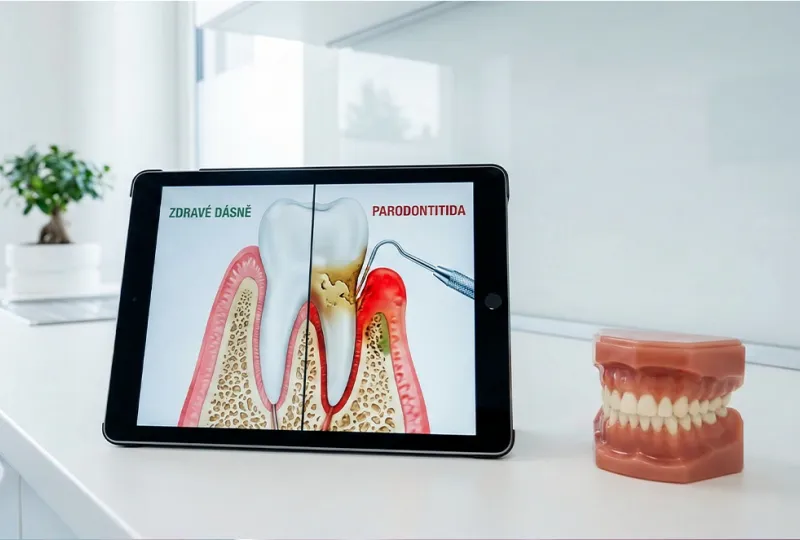
A microbial coating (biofilm) is constantly forming on the teeth. If it is not removed, the bacteria within it begin to produce aggressive enzymes and toxins. These substances disrupt the gum epithelium. Your body responds to this attack by sending white blood cells to the affected area – inflammation occurs. Increased blood flow causes swelling and redness, which is the organism's effort to "flush out" the infection and repair the damaged tissue.
If this condition persists for a long time, the soft plaque mineralizes and dental calculus (tartar) is formed. This has a rough surface that bacteria cling to even better, and the inflammation thus enters a vicious cycle from which there is no way out through home cleaning alone.
Key Difference: Gingivitis vs. Periodontitis
Many patients confuse these terms. However, the difference between them is fundamental – the line between "curable" and "irreversible."
| Gingivitis (Gum Inflammation) | Periodontitis (Periodontosis) | |
| Affliction | Only soft tissue (gum) | Gum, ligaments, and alveolar bone |
| Symptoms | Swelling, redness, bleeding, odor | Receding gums, loose teeth, pus, tooth migration |
| Treatment | Fully reversible state. After removing the cause, the gum heals 100%. | Irreversible state. Bone loss cannot be reversed; the disease can only be stopped. |
Do not let gingivitis progress to the stage of periodontitis. The line can be thin, and you cannot recognize it yourself at home without an X-ray examination.
Gum Inflammation Doesn't Just Harm Teeth: The Connection to Overall Health
Modern medicine has long ceased to view the mouth as a separate part of the body. Chronic inflammation in the mouth means your body is under constant pressure. Bacteria and inflammatory substances penetrate from the gums into the bloodstream and travel throughout the body.
Scientific studies have proven a link between untreated gum inflammation and:
- Cardiovascular diseases: It increases the risk of atherosclerosis and heart attack.
- Diabetes: Gum inflammation worsens blood sugar control and vice versa – diabetics are more susceptible to inflammation.
- Pregnancy complications: In pregnant women, it increases the risk of premature birth and lower birth weight of the child.
Professional Treatment at Clinic for Smile: Step by Step
While home care is maintenance, treatment must take place in the office. Here we solve what a toothbrush cannot handle.
- Diagnostics and Periodontal Indices: First, we measure the depth of the gingival sulci (PBI and CPITN indices). This determines whether it is "only" gingivitis or already incipient periodontitis.
- Removal of Subgingival Calculus: Using ultrasound and hand instruments (curettes), we must remove the hard deposit of dental tartar, which is often hidden under the gum and irritates the bone. This is a key step that cannot be performed at home.
- Vector Therapy and Airflow: We use modern technologies to smooth the tooth root and remove pigmentations. A smooth tooth surface is the best prevention against the re-settling of bacteria.
- Setting up a Recall System: We invite patients with active inflammation for check-ups at shorter intervals (often after 3 months) until the condition of the tissues stabilizes.
Conclusion: Health Starts with Prevention
Gum inflammation is a warning that gives you a second chance. Do not waste it. If you observe symptoms of inflammation, or if you haven't been for dental hygiene for more than a year, it is time to fix it.
Book a gum examination
FAQ: Frequently Asked Questions
Is gum inflammation hereditary?
It is not directly hereditary. You only inherit susceptibility (type of gum, composition of saliva). However, if you have perfect hygiene, inflammation will not develop even with a genetic burden. Bacteria are the cause; genetics is only a factor.
Can inflammation be cured with antibiotics?
Antibiotics alone will not cure gum inflammation. Bacteria are hidden in the biofilm and tartar, where medications cannot penetrate. The foundation is always the mechanical removal of plaque and tartar. Antibiotics are used only in exceptional, acute cases as a supplement.