
The word "periodontitis" (often called gum disease) is a nightmare for many patients. They imagine an unavoidable fate—loose teeth ending up in a glass on the bedside table, just like their grandparents experienced.
However, I have good news: 21st-century dentistry can treat periodontitis very successfully. It is not a verdict of tooth loss; it is a chronic disease that we can stop and stabilize.
What is periodontitis and why does it occur?
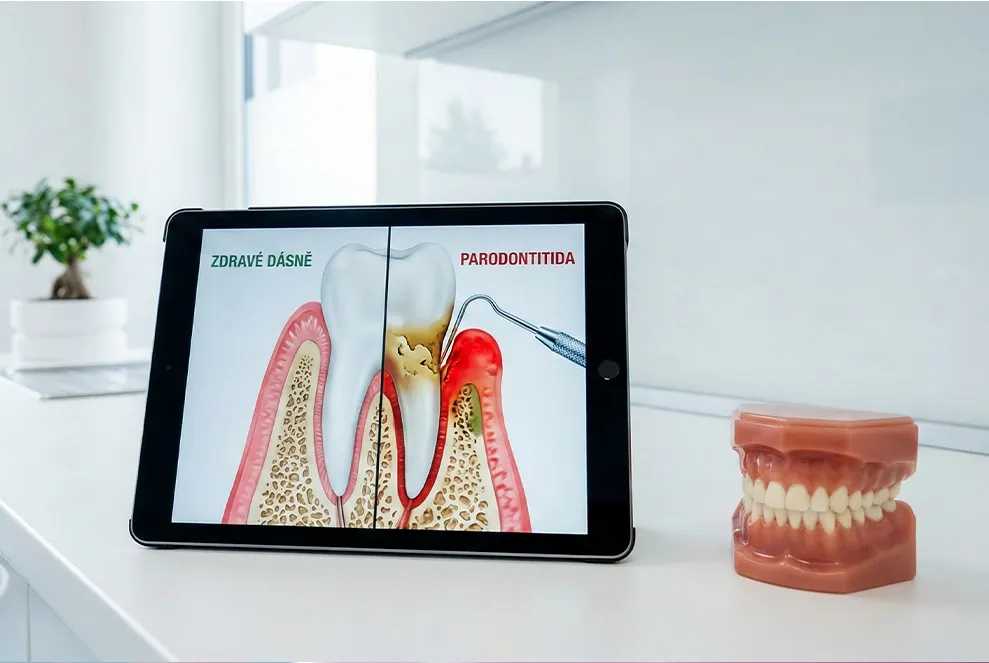
Periodontitis is an inflammatory disease of the tooth's attachment apparatus (the periodontium). This is the system of ligaments and bone that holds your tooth firmly in the jaw. While gingivitis affects only the soft tissue on the surface, periodontitis goes deeper.
- The Mechanism: Bacteria from plaque and tartar penetrate the groove between the tooth and the gum. The body reacts with inflammation and begins to "retreat"—breaking down its own bone to distance itself from the infection.
- The Result: A so-called periodontal pocket forms. It is a deep gap along the tooth root, full of bacteria and tartar, where a toothbrush cannot reach. As the bone recedes, the tooth loses support, begins to wobble, and may eventually fall out, even if it is healthy and cavity-free.
Symptoms: Will you recognize them in time?
Periodontitis is treacherous because it does not hurt for a long time. Pain often arrives only when it is too late. Therefore, watch for these signals:
Early Symptoms (Often Overlooked):
- Bleeding gums: The basic signal of inflammation (more on first aid for bleeding).
- Bad breath: Caused by rotting processes of bacteria in pockets under the gum.
- Swelling and redness of the gums.
Advanced Symptoms (Warning Signs):
- Gum recession: Teeth look "longer," exposing sensitive necks.
- Gaps forming: Teeth begin to fan out (often the front upper teeth).
- Loose teeth: A feeling of uncertainty when biting into harder food.
- Pus discharge: Pus may appear when pressing on the gum.
Stages of the Disease
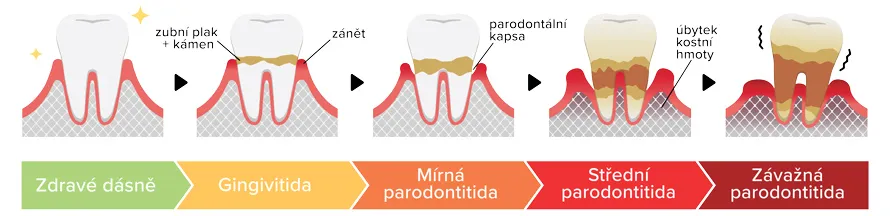
Treatment and prognosis depend on the stage at which we catch the disease.
| Stage | What happens in the mouth | Treatment Prognosis |
| 1. Gingivitis | Inflammation only on the gum, bone is undamaged. | 100% Curable. Return to original state. |
| 2. Incipient Periodontitis | Mild bone loss, pockets up to 4–5 mm. | Excellent. The disease can be stopped without consequences. |
| 3. Moderate Periodontitis | Visible gum recession, pockets over 6 mm, bone loss. | Good. With professional treatment, teeth can be kept for decades. |
| 4. Advanced Periodontitis | Loss of more than 50% of bone, grade II-III tooth mobility. | Uncertain. We fight to save every tooth; complex treatment is necessary. |
Myth: "It runs in the family, nothing can be done"
We hear this often, but the truth is different. You do not inherit periodontitis like eye color; you only inherit susceptibility (gum type, saliva composition, immune response). The rule is: Even with a genetic burden, the disease cannot arise without bacteria (plaque and tartar).
Risk Factor #1 is SMOKING: Smokers have up to a 6x higher risk. Nicotine constricts blood vessels in the gums, meaning smokers' gums do not bleed even with severe inflammation. The smoker loses the warning signal and often comes to the doctor only when teeth are loose.
How do we treat periodontitis at Clinic for Smile?
Forget home remedies. This is an infection deep under the gum requiring mechanical cleaning by an expert.
1. Diagnostics & Hygiene
We take detailed X-rays and measure pocket depths. The hygienist teaches you cleaning techniques, without which treatment cannot work.
2. Deep Scaling
The key procedure. Under local anesthesia (painless), we clean the space under the gum using special curettes and ultrasound to remove hard tartar and smooth the root.
3. Modern Technology
We use devices (Vector, Laser) to destroy bacteria in hard-to-reach places and support healing.
4. Maintenance (Recall)
Periodontitis can be "put to sleep" (stabilized). To keep it that way, regular check-ups every 3–4 months are necessary.
FAQ:
Is it contagious?
Yes, the bacteria are transmissible via saliva (kissing, sharing cutlery). We recommend checking your partner as well.
Can I get an implant?
Yes, but only after curing the gums. Placing an implant in an inflamed mouth carries a huge risk of failure.
Conclusion: It’s a Race Against Time
With periodontitis, a simple rule applies: The sooner you come, the easier and cheaper the treatment is. If you observe any of the symptoms, do not wait until the tooth starts to wobble. At Clinic for Smile, we have a team of experts who will help you stop the disease and restore confidence in your smile.